

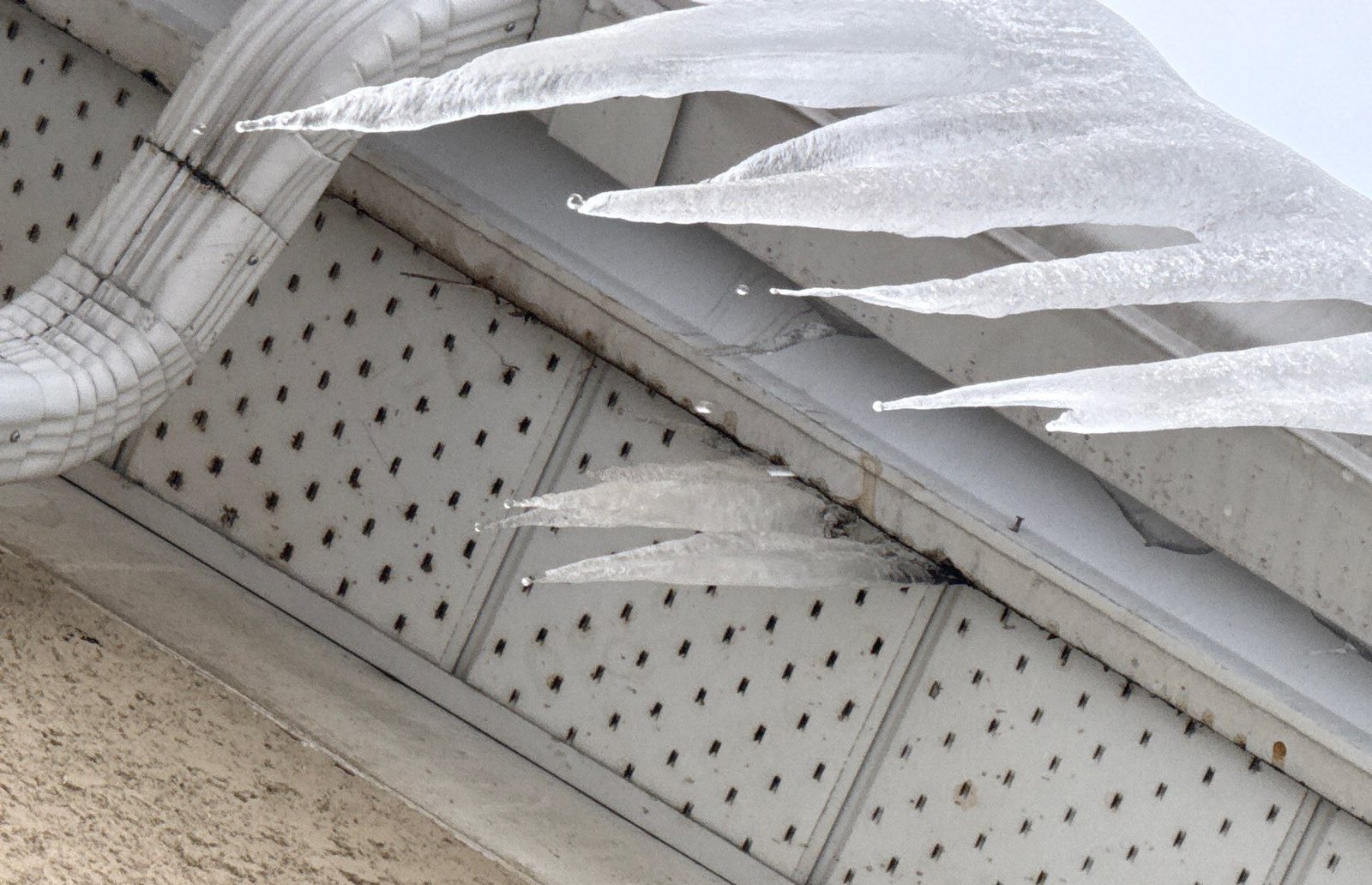
Do heat cables (heat tape) stop ice dams on Minnesota roofs?
Heat cables don't stop ice dams from forming. They keep a narrow path open so meltwater can drain, which helps at gutters, downspouts and valleys. The lasting fix, according to UMN Extension, is sealing attic air leaks and adding insulation.
You're standing in the hardware-store aisle in November, holding a boxed roof de-icing kit, wondering if this is the thing that finally stops the icicles and the brown ceiling stain. Maybe. It depends on where your ice forms and why.
This article is the buying decision. For getting ice off a roof right now, and for the basics of why dams form, see our ice dam removal page.
Do heat cables actually stop ice dams?
Heat cables don't stop the cause of ice dams. Installed correctly before snow falls, they keep a narrow drain path open so meltwater can get off the roof. That can reduce damage at problem spots, but the heat leaking from the house that creates the melt keeps going.
The manufacturers say this plainly. Their manuals describe the cable as a drainage aid, not a snow melter.
Why do ice dams form in the first place?
University of Minnesota Extension says ice dams come from uneven roof temperatures. Heat leaking out of the house melts snow on the upper roof, and the water refreezes at the colder eave.
That's the core of the decision. A cable treats the symptom at the edge. Air sealing and insulation treat the source in the attic.
Where do roof heat cables help?
Cables are most useful at specific trouble spots where meltwater has nowhere to go: gutters and downspouts that freeze solid, valleys, the area around dormers and below skylights, and short eave runs that dam every year.
The Easy Heat manual lists the same places. Depending on sun, wind and roof shape, the problem area "may be the entire roof edge, or it may be specific areas, such as underneath skylights, in roof valleys or around dormers." It also says that if ice has only formed in the gutter and not on the roof, install the cable in the gutter and downspouts only.
Downspouts matter. A cable zig-zagged on the eave does little if the downspout below is a column of ice. The manufacturers route cable down the downspout to open a path all the way to the ground.
Where don't heat cables work?
Cables can't stop dams across a wide roof that loses a lot of heat. They can't clear an existing dam. And many consumer kits aren't rated for flat roofs or metal roofs.
- An ice dam that's already there. Both the Easy Heat manual and spec sheet say the cable isn't for melting ice or snow that has already built up. You also can't clip cable onto a roof under ice.
- Flat and low-slope roofs (with the ADKS kit). The ADKS spec sheet says "Never install on a flat roof" and describes the product for "inclined roofs with tab shingles." Other product lines are rated for more roof types. IceStop's data sheet lists shingle, rubber, tar and metal roofs, but that's an engineered, cut-to-length system with separate connection kits.
- Metal roofs (with the ADKS kit). The spec sheet says it's "Not suitable for use on metal roofs" and to contact the maker for a different product.
- Snow above the cable. The heated zone is only a strip. The spec sheet says the cable goes over the unheated overhang area. Meltwater from farther up can still refreeze above the cable pattern if the attic is dumping heat.
How much electricity do roof heat cables use?
Fixed-wattage kits like Easy Heat's ADKS are rated at 5 watts per foot. Self-regulating cable like Raychem IceStop is rated at 12 watts per foot in ice or snow. Your cost depends on how many hours the cable runs.
From the ADKS spec sheet, the 200-foot kit (ADKS-1000) draws 1,000 watts. That's 1 kilowatt-hour for every hour it's on.
For a rough estimate, Xcel Energy's Minnesota residential rate sheet (effective January 1, 2024) lists a standard energy charge of $0.11364 per kWh for non-summer months. Riders and fees apply on top, and rates change, so check your own bill.
Are heat cables a fire or shock risk?
They can be when damaged or installed wrong. Both manufacturers require ground-fault protection, and Easy Heat limits its kit to a grounded 120-volt outdoor receptacle on a circuit of 20 amps or less.
Two more manual rules people break: ADKS cable "cannot be cut or altered" (cutting it voids the warranty). And the receptacle has to be within the 6-foot cord length of where the cable starts on the roof.
Can heat cables damage shingles or affect the roof warranty?
It depends on how they're attached. Use the clips and spacers that come with the kit, and don't drive extra nails or screws through shingles. Every nail hole is a potential leak right in the zone where water backs up.
Warranty terms vary by shingle maker. Ask the manufacturer, or your roofer, before anything gets fastened to a newer roof. Keep the answer in writing with your warranty papers.
Not sure if cable or attic work is the right fix?
We'll look at where your ice forms and what's feeding it before you buy anything.
Request an Ice-Dam Prevention AssessmentWhat's the permanent fix for ice dams?
UMN Extension's long-term fix is to seal the air leaks between the house and the attic first, then add ceiling or roof insulation. Ventilation plays a supporting role.
Extension also recommends hiring a weatherization contractor who runs a blower door test and may use an infrared camera to find heat loss. It advises waiting to repair interior damage until ceilings and walls are dry, and doing it together with fixing the heat loss so the damage doesn't come back.
It flags a couple of things that raise ice-dam risk: recessed lights, skylights, complicated roof designs, and heating ducts in the attic. Bath or kitchen exhausts ending just above the roof, plus chimneys, can also melt snow.
Should I buy heat cables? A quick decision table
Buy cable for a specific drainage problem you can point to. Don't buy it as a substitute for fixing attic heat loss.
| Your situation | Will cables help? | Better or first fix |
|---|---|---|
| Gutters and downspouts freeze solid, but no ice on the roof itself | Yes. The manual says gutter and downspout only. | Also check gutter pitch and downspout outlets. |
| One valley or dormer dams every winter | Often, as a targeted drain path | Look for air leaks and thin insulation under that spot. |
| Ice dams along most of the eaves, big icicles all around | Only partly. Water can refreeze above the cable. | Air seal, then insulate the attic (UMN Extension). |
| An ice dam is already built up and leaking | No. Manufacturers say not for existing ice. | Steam removal, then fix the cause. |
| Flat or low-slope roof section | Not with the ADKS kit. It needs a product rated for that roof. | Drainage and insulation review. See flat roofing. |
| Metal roof | Not with the ADKS kit | Ask the cable maker for a metal-roof product. |
| Snowmelt stains on a ceiling after a thaw | Maybe at the edge. It won't fix the source. | Roof and attic inspection before interior repairs. |
When should heat cables be installed?
Install before the snow comes, on a dry roof with no ice. The Easy Heat manual says the cable may be installed when there is no ice or snow on the roof.
- Map last winter's ice. Photos of where icicles and dams formed tell you where cable belongs.
- Measure using the maker's method. The ADKS sheet multiplies roof-edge length by an overhang factor (5.3 for a 24-inch overhang). Then it adds downspout length, 6 feet per valley, and dormer perimeters.
- Confirm the outlet. Grounded, ground-fault protected, 20 amps or less, within 6 feet of the cable start.
- Plan the controls. A thermostat or moisture control keeps the cable from running all season.
- Book the attic work. Air sealing and insulation are what cut down the melt that feeds the dam.
If ice is already on the roof this season, skip the ladder. UMN Extension warns that working on a winter roof risks injury and roof damage, and recommends calling professionals. Our emergency roof repair team handles active leaks. If a roof replacement is coming anyway, ask about what goes under the shingles at the eaves.
Find out what's really feeding your ice dams
Before you buy cable, we'll check where the ice forms and what the roof and attic are doing, and document it with photos.
Questions people also ask
Can I put heat cable on a roof that already has an ice dam?
No. Easy Heat's manual says not to install its cable to remove existing ice dams or snow. The cable can't be clipped on properly over ice. Deal with the existing dam first, for example by steam removal.
Should I leave roof heat cables on all winter?
Only if you accept the power cost. A 1,000-watt kit uses 1 kWh every hour it runs. Easy Heat recommends a control so the cable turns on only when needed.
Do roof heat cables need a GFCI outlet?
Yes, they need ground-fault protection. Easy Heat requires a grounded, ground-fault protected 120 V outdoor receptacle on a 20-amp-or-less circuit. Raychem requires ground-fault equipment protection on each heating cable circuit.
Is attic ventilation or a powered attic fan the answer to ice dams?
UMN Extension says mechanical attic ventilation is not a recommended ice-dam solution in Minnesota. It puts air sealing first and insulation second. Natural ventilation plays a supporting role.
Sources
- Dealing with and preventing ice dams (University of Minnesota Extension)
- ADKS Roof & Gutter De-Icing Kit product manual (Easy Heat (Emerson))
- ADKS Series specification sheet (Easy Heat)
- IceStop Roof & Gutter De-Icing data sheet (Raychem / Chemelex (formerly nVent))
- Minnesota Electric Rate Book, Section 5 (Residential) (Xcel Energy)
Repair King is a licensed contractor, not an insurance company, public adjuster or attorney. We inspect, document and repair. Coverage decisions belong to your insurer, so read your own policy and ask your agent.


