

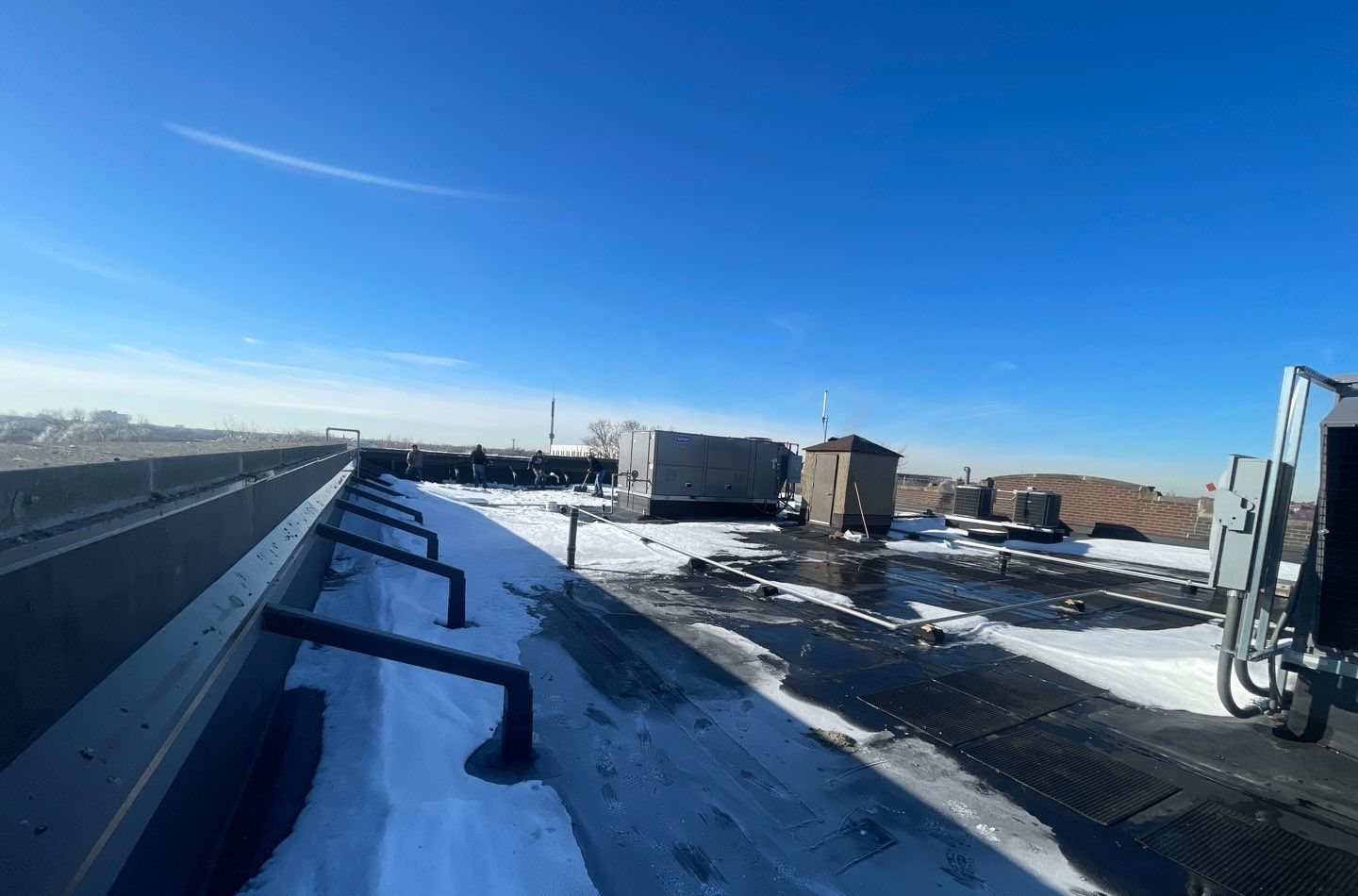
How Much Snow Can a Flat Roof Hold in Minnesota, and When Should It Be Cleared?
Minnesota Rules 1303.1700 sets a 50 psf ground snow load for Twin Cities counties, but a flat roof's actual capacity depends on its design and condition, and it's listed on the structural drawings or determined by an engineer. Clear snow when loads approach that design capacity, starting with drifts, leaving about 2 inches on the membrane.
That 50 pounds per square foot gets quoted a lot every February, and it gets misread a lot too. It's the design starting point for the snow on the ground. What your flat roof can actually carry depends on how it was designed and what shape it's in now.
This guide is for owners and property managers of flat and low-slope buildings (and the owners of flat-roof homes). It covers what the numbers mean, when snow starts to become a problem, and how to clear it without tearing the membrane or hurting anyone.
What does "snow load" mean on a flat roof?
Snow load is the weight of snow and ice on a surface, measured in pounds per square foot (psf). A roof's design snow load is the weight its structure was engineered to carry, and it's usually listed on the building's construction drawings.
There are two numbers people mix up. Ground snow load is the weight of snow on open ground, and the code sets that. Roof snow load is what engineers calculate for a specific roof, starting from the ground number and adjusting for the building.
So two buildings on the same block can have different capacities. A heated office with a clean, open roof and an unheated warehouse behind a tall parapet were not designed to the same number.
What ground snow load does Minnesota code require in the Twin Cities?
Minnesota Rules 1303.1700 sets the ground snow load at 50 psf in the Twin Cities metro and most of southern Minnesota, and 60 psf in 29 northern counties. Engineers start their roof design from that number.
Two cautions. First, the code number applies to design, not to a roof built decades ago under older rules. FEMA notes that drifting loads first showed up in the BOCA code (used across much of the Midwest) in 1975, and that a building constructed 40 years ago may not have been designed for snow loads as they're understood today.
Second, don't use ground snow to judge the roof. FEMA says outright that measuring ground snow weight and assuming the roof carries the same load is incorrect.
How much does snow weigh per foot?
It depends on how wet it is. FEMA puts a foot of fresh snow anywhere from 3 psf (light and dry) to 21 psf (wet and heavy), and a foot of ice at about 57 psf.
| Material | Weight |
|---|---|
| 1 ft of light, dry fresh snow | about 3 psf |
| 1 ft of wet, heavy fresh snow | about 21 psf |
| 1 inch of ice | a little under 5 psf |
| 1 ft of ice | about 57 psf |
That's why depth alone tells you very little. Two feet of January powder can weigh less than eight inches of ice left behind by a March thaw.
Weather also changes what's already up there. FEMA explains that rain on snow can saturate it and add a lot of weight, and roof snow left in the sun softens, gets denser, and then hardens again when the temperature drops.
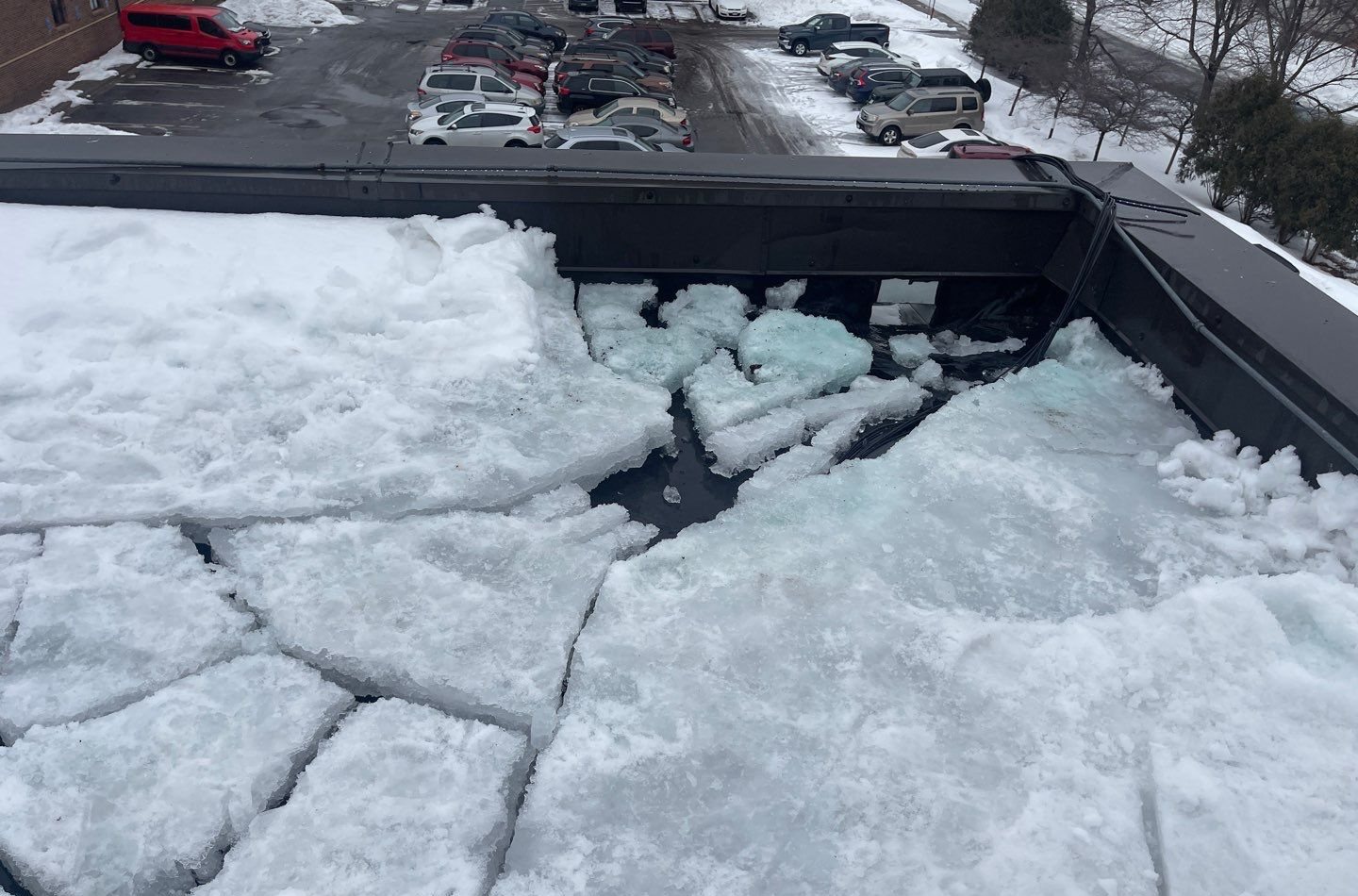
Where does snow pile up most on a flat roof?
Snow drifts deepest against parapets, at step-downs where a lower roof meets a taller wall, and around rooftop units and penthouses. Those spots can carry far more weight than the open middle of the roof.
Wind scours the open field of a flat roof and drops the snow where it hits something. FEMA calls this unbalanced loading and says it poses a greater risk to the structure than an even blanket of snow.
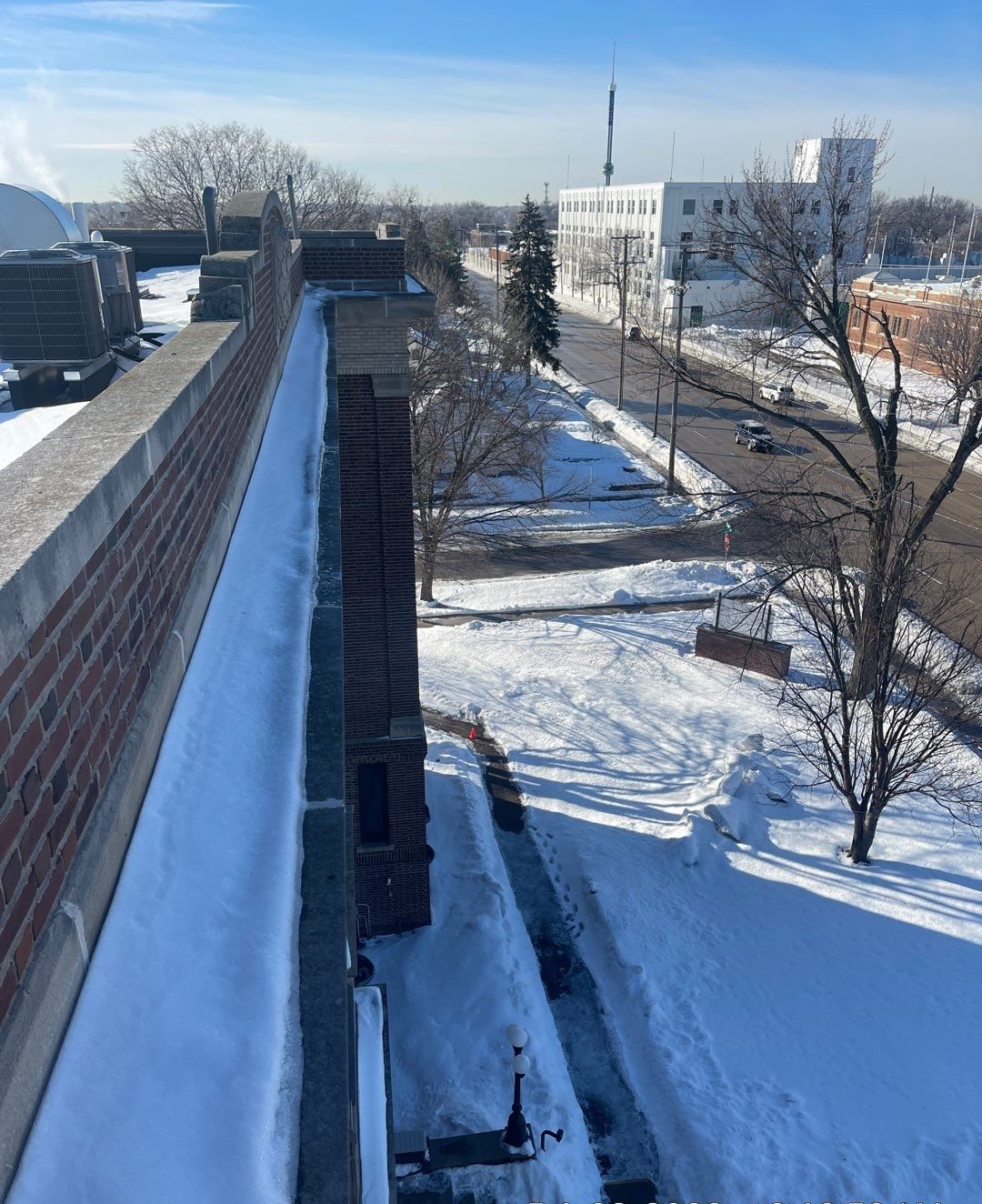
Take note of where drifts form on your building each winter. That's where you look first after a storm, and it's where snow removal should start.
What are the warning signs a flat roof is overloaded with snow?
Sagging ceilings or sprinkler heads, popping or creaking sounds, and doors that suddenly stick are the main signs. If you see any of them, FEMA says to evacuate the building and call a qualified design professional, such as a structural engineer.
FEMA's list, for wood, metal, and steel buildings:
- Sagging ceiling tiles or boards, or boards falling out of the ceiling grid
- Sagging sprinkler lines, or sprinkler heads dropping below a suspended ceiling
- Popping, cracking, or creaking noises
- Sagging roof members, including metal decking or plywood sheathing
- Bowing truss bottom chords or web members
- Doors or windows that can no longer be opened or closed
- Cracked or split wood members, or cracks in walls or masonry
- Severe roof leaks
- Water collecting where it shouldn't on a low-slope roof
When should snow be removed from a flat roof?
Remove snow when the load is getting close to the roof's design capacity, or when it's somewhat close and more snow is in the forecast. Knowing the design snow load for your specific building is what makes that call possible.
FEMA's guidance also covers the in-between case: even if a storm doesn't reach the limit, clearing may still make sense when more snow is on the way or the snow is turning to ice. For light snowfalls it goes the other way. The risk of damaging the roofing or of being on the roof can outweigh the benefit.
Plan ahead. FEMA points out that contractors are in high demand and hard to find once a storm starts, so large facilities should decide before the season whether in-house staff or a contractor on retainer will do the work.
Know your roof before the first big storm
We'll inspect the membrane, drains, and drift areas and photo-document what we find, so your snow plan starts with facts.
Schedule a commercial roof inspectionHow do you remove snow from a flat roof without damaging the membrane?
Leave at least 2 inches of snow on the roof, use plastic shovels instead of metal ones, and never use picks, snow blowers, or other mechanical equipment on a membrane. Clear drifts first, then work evenly from the center out.
- Mark hazards first. Skylights, vents, conduit, gas lines, and drains disappear under snow. FEMA recommends flagging them before the season.
- Start with the drifts. Clear heavy snow at parapets, elevation changes, and around equipment before anything else.
- Work from the center, evenly. Remove the remaining snow starting in the middle and moving in the direction of the main structural members, so you don't create a new unbalanced load.
- Leave a layer. FEMA says to leave at least 2 inches. Scraping down to the membrane is how roofs get cut.
- Don't pile snow on the roof. Drop it in a designated ground area away from exits, fire escapes, downspouts, vents, and equipment.
Is it safe for maintenance staff to shovel a commercial roof?
Only with a plan and fall protection. OSHA says falls cause most of the deaths and serious injuries during rooftop snow removal, and it tells employers to use ground-based methods when they can.
FEMA's guide also recommends that roof snow removal be done by a licensed, insured roofing contractor experienced in it, and that someone on the ground keep people away from where snow and ice will fall.
Why does a flat roof leak after the snow melts?
Usually because the meltwater can't get off the roof. Blocked drains, iced-over scuppers, or low spots let water pond, and ponded water adds concentrated weight and finds every weak seam.
FEMA calls this ponding and notes it happens on flat and low-slope roofs with poorly designed or blocked drainage. Between storms, a working drain system actually lowers the load. A plugged one does the opposite.
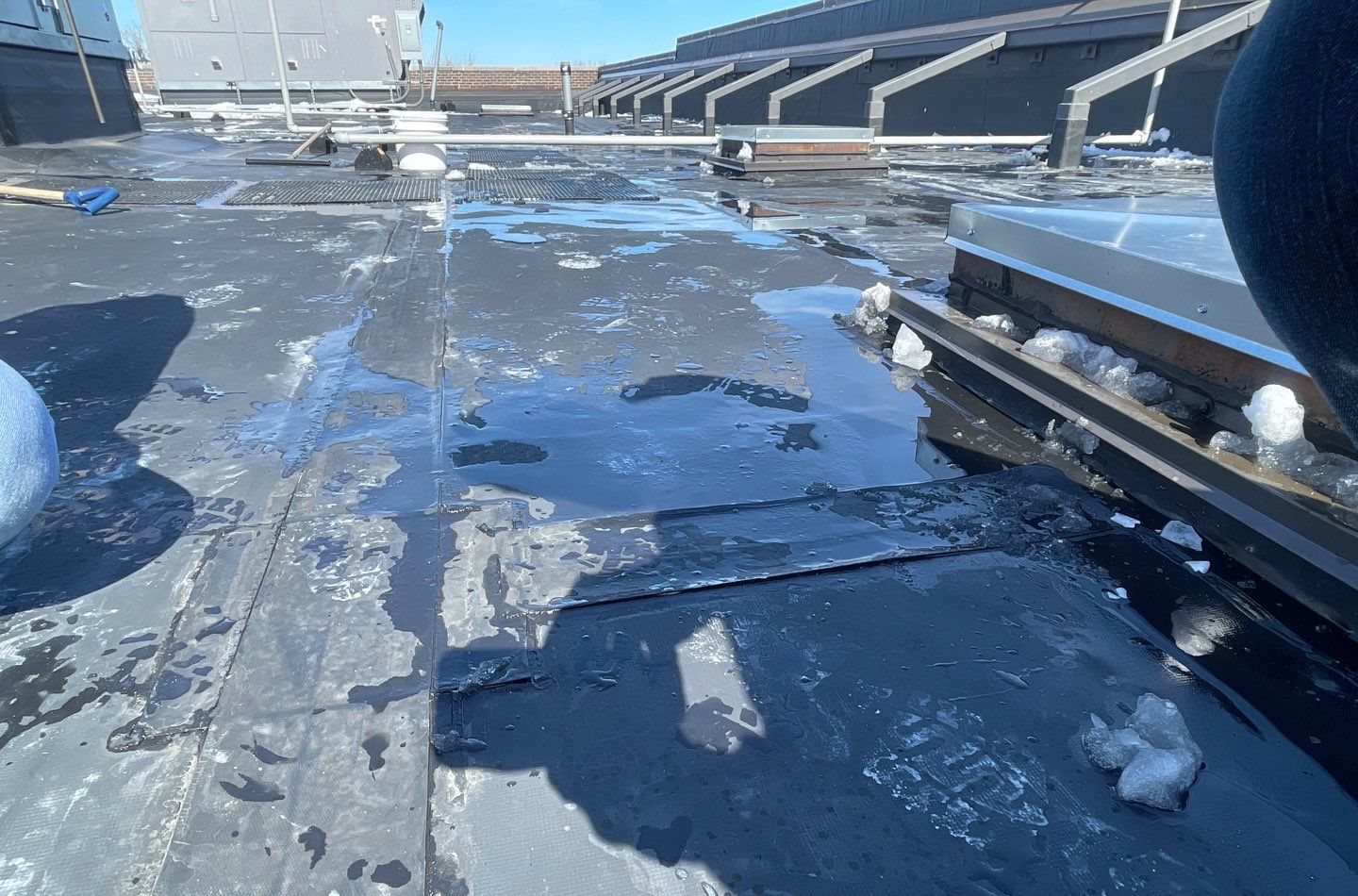
If a leak shows up during the thaw, our flat roof repair page covers how we track leaks to the source. For water coming in right now, see emergency roof repair.
Should I call a structural engineer or a roofer?
Call a structural engineer for anything about capacity or structural distress: unknown design loads, sagging, creaking, or cracks. Call a roofer for the membrane, drains, flashings, leaks, and safe snow removal.
| Situation | Who to call |
|---|---|
| You don't know the roof's design snow load | Licensed professional engineer |
| Sagging ceiling, dropped sprinkler heads, sticking doors, creaking | Evacuate, then a structural engineer or the local building official |
| Heavy drifts or ice need to come off | Experienced, insured roofing contractor |
| Leaks, torn membrane, blocked drains, ponding after melt | Roofing contractor |
A roofer can tell you what's happening on the surface and document it. We don't tell anyone what load their structure can carry. That's an engineer's call.
Managing several buildings? Our maintenance agreements put pre-winter inspections and drain checks on a schedule, and our property manager page covers storm response across a portfolio.
Get your flat roof checked before the snow piles up
Repair King inspects membranes, drains, scuppers, and drift areas on Twin Cities commercial roofs and photo-documents what we find.
Questions people also ask
How much snow should be left on a flat roof when shoveling?
FEMA's Snow Load Safety Guide says to leave at least 2 inches. Scraping down to the surface is a common way membranes get cut or punctured, which trades a weight problem for a leak.
Can I use a snow blower on a flat commercial roof?
FEMA advises against mechanical snow removal equipment on roofs because the risk of damaging the membrane and rooftop items outweighs the speed. Use plastic shovels and non-metallic tools.
Is the 50 psf in Minnesota code the weight my roof can hold?
No. 50 psf is the ground snow load engineers start from in Twin Cities counties under Minn. R. 1303.1700. Your roof's design load is calculated from it and adjusted for shape, exposure, and other factors, and older buildings may have been designed under different rules.
How do I find my building's design snow load?
Check the structural construction drawings, usually in the general notes. If there are no drawings or the number isn't listed, FEMA recommends hiring a licensed professional engineer before the snow season.
Does a flat-roof house in Minnesota face the same snow risks?
The same physics apply: drifting against walls, heavy wet snow, ice, and blocked drains. OSHA and FEMA both suggest clearing from the ground with a non-metallic roof rake when possible instead of climbing up.
Sources
- Minn. R. 1303.1700 Ground Snow Load (Minnesota Office of the Revisor of Statutes)
- FEMA P-957 Snow Load Safety Guide (2013) (FEMA (via GovInfo))
- Falls and Other Hazards to Workers Removing Snow from Rooftops and Other Elevated Surfaces (OSHA 3513) (OSHA)
Repair King is a licensed contractor, not an insurance company, public adjuster or attorney. We inspect, document and repair. Coverage decisions belong to your insurer, so read your own policy and ask your agent.


