
💰 Where’s the money? Roof financing, home repair grants & programs
Most homeowners only know about one.
You may be able to stack more than one. Tap any card to jump to it.
Grants & forgivable loans
City, county and state programs. Type your address and see which ones cover your home.
Find my grants →Monthly payments
Prequalify in about a minute. Soft credit check, no hit to your score.*
See my payment →Insurance coverage
Hail or wind damage may be covered by your homeowner’s policy. We document it so you have clear records.
Check my storm history →Business write-off
Section 179 lets many commercial roofs be expensed in year one (2026 limit).
Run the numbers →Fix it now. Pay over time.
See your payment options in about a minute. Checking won’t affect your credit score.* Perfect credit not required.
Prequalify in a minute
Answer a few questions on your phone. It’s a soft credit check, so your score isn’t touched.*
Pick a payment that fits
Terms from 12 up to 240 months. Choose a lower monthly payment or a faster payoff.
We get to work
Your project gets scheduled and done right. You make simple monthly payments to Foundation Finance.
What would my payment be?
Slide to your project size and pick a term. It’s a quick way to see what’s possible before you prequalify.
Example only, not an offer of credit. Your actual APR, term and payment come from Foundation Finance after you apply, and depend on your credit. Projects under $7,500 have terms up to 120 months.
Storm damage? Your policy may cover it.
If hail or wind damaged your roof, siding or gutters, your homeowner’s insurance may pay for the repair. Your insurance company decides what’s covered. We inspect, photograph and document the damage so you have clear, dated records to share with them.
Deduct it this year. Pay for it monthly.
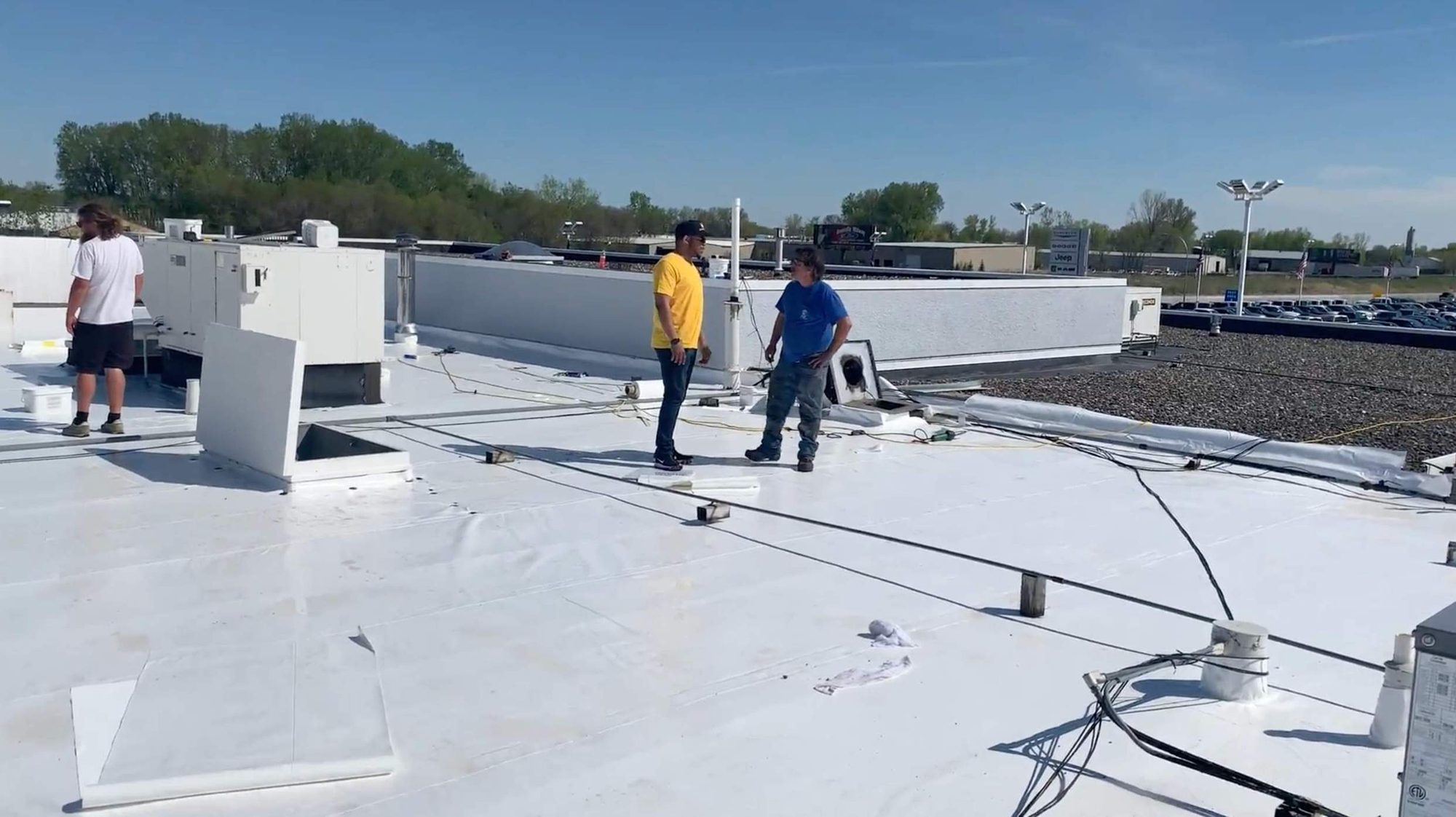
Under Section 179, a new roof on nonresidential property placed in service in 2026 can qualify to be expensed, up to $2,560,000 (Rev. Proc. 2025-32). Pair that with monthly payments and the first-year tax savings can cover a big share of what you pay that year.
Illustration only, not tax or credit advice. Section 179 applies to qualifying roofs on nonresidential buildings, is limited to your business’s taxable income, and phases out above $4,090,000 of qualifying purchases. Your CPA confirms how it applies to you. Commercial financing terms vary by lender and credit; ask us about options for your property.
Patching and waiting usually costs more.
Same house, three choices. A small monthly payment often beats paying twice.
Patch it every year
- Repair calls $400–$900 each
- Problem fixed? Not really
- Interior damage risk Keeps growing
- Value added to home None
Replace now, finance it
- Upfront cash Little or none
- Problem fixed? Yes, done right
- New roof warranty Yes
- Adds to home value Yes
Wait and save up
- Time to save Often years
- Leaks reach decking & insulation Likely
- Material prices Have been rising
- Stress level High
Example ranges for illustration. Your free inspection tells you exactly what your roof needs, including whether a repair is enough.
All 28 grant & loan programs
Rather browse than type your address? Tap your area to open it. Official links only, checked September 28, 2026.
Statewide (all of Minnesota)4 programs
Minnesota Housing Rehabilitation & Emergency Loans (RLP/ELP)
Deferred, 0% loans for low-income homeowners, up to $37,500, for safety, livability, energy or accessibility repairs. Forgiven if you don't sell, transfer or move out during the loan term. Apply through your county or a participating lender.
Official page →Minnesota Housing Fix Up Loan
Home improvement loans for owner-occupants. Twin Cities metro income limit: $196,600 (loans locked on or after July 1, 2026).
Official page →Weatherization Assistance Program
Free energy upgrades (insulation, air sealing, heating safety) for households at or below 200% of federal poverty guidelines. Priority for seniors, people with disabilities and families with children.
Official page →Rebuilding Together Minnesota
No-cost critical repairs, roofing, safety and ramps for low-income homeowners. The 2026 application window opens October 1 and closes December 31.
Official page →Hennepin County3 programs
Hennepin County home repair loans
0% interest, no monthly payments, up to $30,000. Can be forgiven if you keep living in and owning the home. Income limits apply.
Official page →Hennepin County lead paint removal grant
Free lead test plus up to $15,000 of lead repair work (often windows) for homes built before 1978 where a child under 6 lives or visits. Income limits apply.
Official page →CAP-HC Energy-Related Repair
Repair or replacement of a broken heating system for income-eligible homeowners in Hennepin County.
Official page →Ramsey County2 programs
Critical Repair Grant & Residential Rehab Deferred Loan
Two county programs for low-to-moderate income homeowners: health and safety repairs, code issues and accessibility. Cosmetic work isn't covered.
Official page →Ramsey County lead grant (Lead at Home)
Replaces lead-painted wood windows and fixes other lead hazards in homes with a child under 6. The grant covers 80% of the project; you pay 20%. Income below 80% of Twin Cities median.
Official page →Dakota County1 program
Dakota County CDA Home Improvement Loan
Interest-free, no monthly payments, $15,000 to $35,000, repaid when you sell or move. Commonly used for windows, siding, roofs and furnaces. Low- and moderate-income homeowners.
Official page →Anoka County1 program
Anoka County Home Improvement Loans
Deferred-payment loans for income-eligible homeowners to fix health and safety issues, emergency conditions or accessibility. First come, first served wait list. No cosmetic updates.
Official page →Washington County1 program
Washington County CDA Home Improvement Loans
Low-cost loans for critical repairs on single-family homes (a rundown roof, plumbing or electrical, exterior doors, code violations, accessibility). Income up to 80% or 115% of area median, depending on the program.
Official page →Carver & Scott Counties2 programs
Carver County CDA rehab loans (RLP/ELP)
Deferred loans for income-eligible homeowners to address health and safety concerns. A lien is placed on the home and the loan is forgiven over time.
Official page →Scott County CDA: Shakopee home improvement loan
0% loans for low- and moderate-income Shakopee homeowners, including roof and furnace replacement. Scott County CDA refers other residents to partner programs.
Official page →City of Minneapolis3 programs
Minneapolis home improvement financing
Loans from $2,000 to $75,000 (some with no monthly payments) for owner-occupied 1–4 unit homes. Income limits apply.
Official page →Minneapolis Healthy Homes renovation grants
Grants to create lead-safe, healthy homes. Some grants have income requirements.
Official page →Truth in Sale of Housing (TISH)
Selling? Single-family homes, duplexes and townhouses need a TISH evaluation by a city-licensed evaluator, and the full report must exist before the home can be shown.
Official page →City of Saint Paul4 programs
Saint Paul Healthy Homes grant
Up to $50,000 for approved measures for qualifying homeowners. The city pays contractors directly and you don't repay it.
Official page →Saint Paul Citywide Home Improvement Loan
Below-market-rate loans for owner-occupied homes, run with NeighborWorks Home Partners.
Official page →Saint Paul Citywide Deferred Emergency Loan
For emergency repairs. Forgiven after 30 years unless the owner sells or moves.
Official page →Truth-in-Sale of Housing (TISH)
Selling? Single-family, duplex, condo and townhome sales need a TISH evaluation before the property is marketed.
Official page →Suburban city programs3 programs
Hopkins housing rehab deferred loans
Forgiven over 15 years. Repay any remaining balance only if you sell before then.
Official page →City loans through CEE (Edina, Minnetonka, Roseville, Anoka and more)
Many cities offer special home improvement loans, deferred loans and grants through the Center for Energy and Environment. Check the list for your city.
Official page →Point-of-sale rules: Bloomington, Richfield, South St. Paul, Golden Valley
These cities require a city inspection or report before a home is sold or advertised (Golden Valley: sewer inspection). Check your city before listing.
Official page →Commercial & multi-unit buildings4 programs
MinnPACE (commercial PACE financing)
Up to 100% financing for energy and renewable improvements, repaid through a property assessment. For commercial, industrial, multi-unit, nonprofit, faith-based and agricultural properties. Run by the Saint Paul Port Authority.
Official page →Minneapolis Great Streets facade matching grants
Matching grants of $5,000 to $10,000 per storefront, depending on the area, for repairs and updates to the front of a building in eligible business districts.
Official page →Saint Paul Neighborhood STAR grants
Grants for physical (capital) improvement projects of $5,000 or more in Saint Paul, for businesses, nonprofits and other organizations. Homeowners aren't eligible.
Official page →Saint Paul Business Assistance Fund
Financing for new and existing businesses that need capital to improve or grow.
Official page →Programs change, fill up and close, and each one decides who qualifies. Repair King doesn’t run or approve any of them.
Money questions, answered.
Where can I find money to fix my house in Minnesota?
There are four common sources: city, county and state repair grants and forgivable loans; contractor financing with monthly payments; your homeowner’s insurance if the damage came from a storm or other covered event; and, for business property, the Section 179 tax deduction. Type your address at the top of this page to see the programs that cover your home.
Are there grants to fix my house in the Twin Cities?
Yes. Minnesota Housing, most metro counties and cities like Minneapolis and Saint Paul offer grants, forgivable loans and low-rate loans for home repairs. Most have income limits and cover health, safety, energy and code repairs rather than cosmetic work. Each program decides who qualifies.
Will checking financing hurt my credit?
No. Prequalifying uses a soft credit pull, which doesn’t affect your credit score.* A full application happens only if you decide to move forward.
Do I need perfect credit for roof financing?
No. Foundation Finance works with a wide range of credit profiles. You’ll see what you qualify for in about a minute.
How long can I take to pay?
Terms run from 12 up to 240 months for larger projects, and up to 120 months for projects under $7,500. There’s no prepayment penalty, so you can pay it off anytime.
Can I use a grant and financing together?
Often, yes. Many homeowners use a program for part of the work and a monthly payment for the rest. Program rules vary, so check with the program before work starts.
Does insurance pay for a new roof?
If a covered storm damaged your roof, your homeowner’s policy may pay for the repair or replacement. Your insurance company decides coverage. We inspect, photograph and document the damage so you have clear records to share with them.
Does Repair King run these grant programs?
No. Each program is run by the agency linked on this page. We checked every one on its official page on September 28, 2026. We can inspect and give you a written estimate for your application.
Fair prices. Real options.
“…working with me to find other options when other contractors wanted to engage in much bigger and more expensive projects. Fast, high quality, and affordable…”
“Fairly priced, efficient, on time, no drama”
Let’s find your money.
Type your address for grants, or see your payment options in about a minute.
*Prequalification uses a soft credit inquiry that does not affect your credit score. Financing is provided by Foundation Finance Company LLC, not Repair King, and is subject to credit approval. Not all applicants will qualify. Rates, terms and promotional offers vary and are set by the lender. Payment examples are illustrations only and are not an offer of credit. Grant and loan programs are run by the agencies linked, which decide eligibility. Insurance coverage is decided by your insurance company under your policy. Tax information is general education, not tax advice; consult a qualified tax professional. Licensed MN contractor BC695228.